Wednesday, 11 September 2013

National Bedroom tax Meeting

I was in Manchester on Saturday for a meeting to plan the next stage of the Bedroom Tax campaign, followed by a meeting to gather evidence, attended by Raquel Rolnik, UN Special Rapporteur on Housing. I've left posting until now on her request, as she wanted us to give her time to make her preliminary report to the government.

At the first meeting, there was a lengthy discussion of the state of affairs round the country. The campaign is patchy, but in some places progress has been made, and the results are being seen in the trickle of councils committing themselves to no-eviction policies. Significant protests have been held in some cities, but there's no consistent picture. People are finding a lot of public support for the campaign.

We need to put pressure on the Labour Party; if they can be persuaded to commit themselves to repealing the tax, that will then put pressure on every Labour council across the country to institute a no evictions policy. Once the Bedroom Tax is eventually defeated, we can't just go home like we did after the Poll Tax campaign;  there are too many othe issues we also need to tackle.

Some ates were set:

Sunday 29th September : TUC March on Tory Party Conference - Manchester

From October 4th - Bedroom Tax - The TRAINing Day.
Leafletting and stalls outside rail stations across the UK.

Saturday 26th October: National Day Of Action Against The Bedroom Tax 


After a break, we moved to a bigger room for a session with Raquel Rolnik. She began by explaining her role. She's a former government minister from Brazil, working for the UN on a voluntary basis. She visits two countries a year, looking at housing issues, and is completely independent. She asks the government to invite her and the protocol is that they then do so. She prepares her report, and gives it to the UN General Assembly. Her preliminary report was given today, and despite Grant Shapps' spluttering over its contents, the procedure appears to have been followed properly, with the knowledge and cooperation of the government. Shapps' letter of complaint to the UN can be seen here. She spent a fortnight in the UK, visiting various cities to collect evidence. Written evidence may still be sent to her at srhousing@ohchr.org , until 26 October.

A series of people then gave their testimony. What we heard was terrible, but no different from what I've been hearing over the last few months. they were videoed, so rather than attempt to summarise them, I'll give the Youtube links; 1, 2, 3, 4, 5, 6, 8, 9, 10, 11, 12, 13, 14, 15. There doesn't seem to be a Number 7. The stories are horrific, and well worth watching. Ms Rolnik's extremely forthright response is here:


She says that there is a retrogression of human rights in the area of housing; we're going backwards, and that the governent's housing stimulus will do nothing to alleviate the need. The Bedroom Tax should be stopped immediately.

When it's finished throwing its dummy out of the pram, the government will no doubt ignore the report. However, it's getting extensive cover in the Press, and won't be forgotten; htere's a good article in the Guardian, for instance. It's very much to be hoped that judges here will take it into account when considering Bedroom Tax cases, and it should make it easier to get the Labour Party to commit to repeal. Other countries are expected to take notice of UN findings, and Britain should not be an exception.

EDIT: This post on Grant Shapps' complaint includes Ms Rolnik's preliminary report. We need to campaign for all of this - not just the reccommendatin regarding the Bedroom Tax - to be implemented.

Friday, 6 September 2013

The Library of Birmingham


It's an impressive building, no doubt about it. The truth, of course, is that they took the most expensive option, with the least shelf space of all the alternatives, and saddled the city with so much debt that it's going to take a generation to pay it off. Meanwhile, despite the flashy new premises, the library is suffering. I'll get back to that.


There was quite a queue to get in, which got a lot worse during the day. There were a lot of security on, and they were still there the following day. I hope they won't be a permanent feature. Inside was a stall with a team of commentators blathering on non-stop. The noise is quite distracting if you're in the fiction section at the bottom, and I don't get the idea.

Further up in the building, it's a lot quieter. Shelves aren't labelled, signposting is poor, and some of the shelving almost seems random. I can't make out why the Romans would be stuck in the middle of modern European history. These are teething problems, however. There's a lot of empty shelf space, and more books shelved, as far as I can see, than there were in the old library.


The problems emerged when I checked over the Biblical Studies section. Twenty years ago, it was good, but there isn't much to attract me now. There's the odd book; they have several on the 'Gospel of Judas', for instance, which attracted a bit of publicity a few years ago. But the heart of any Biblical Studies library will always be its collection of commentaries. To keep up, they need, roughly speaking, to buy one academic commentary on each canonical book every 5-10 years. It hasn't been happening. There are a few things, like the Anchor Bible volumes on the Apocrypha, which are useful, useful, as my own collection is pathetic on Apocrypha. But by and large, their books duplicate mine, at least where they interest me. It's not a section I'd go very far to use, and that's a pity, given that this is a major national library.

A library is only as good as its books, and despite what some are saying, books is what it's all about. If possible, there should be space for ancillary acitivities; literary groups and author readings, for instance, and a cafe (the ones in the new library are privatised, and apparently the seats are uncomfortable) where you can discuss books, or read them over your coffee. But a library is only as good as its books.

A library with national standing, such as this aspires to be, needs more than that, of course. It needs a teacm of skilled librarians, a pool of experts on every subject under the sun, to guide tham on buying decisions, and a decent budget for purchases. In five years' time, or fifty, nobody's going to come to admire the building. They'll come for the books, or not at all.

And then, of course, the collection needs to be accessible to all. It won't be if it's privatised and run for profit, as the council seems to want.


Sunday, 21 July 2013

EDL Rally


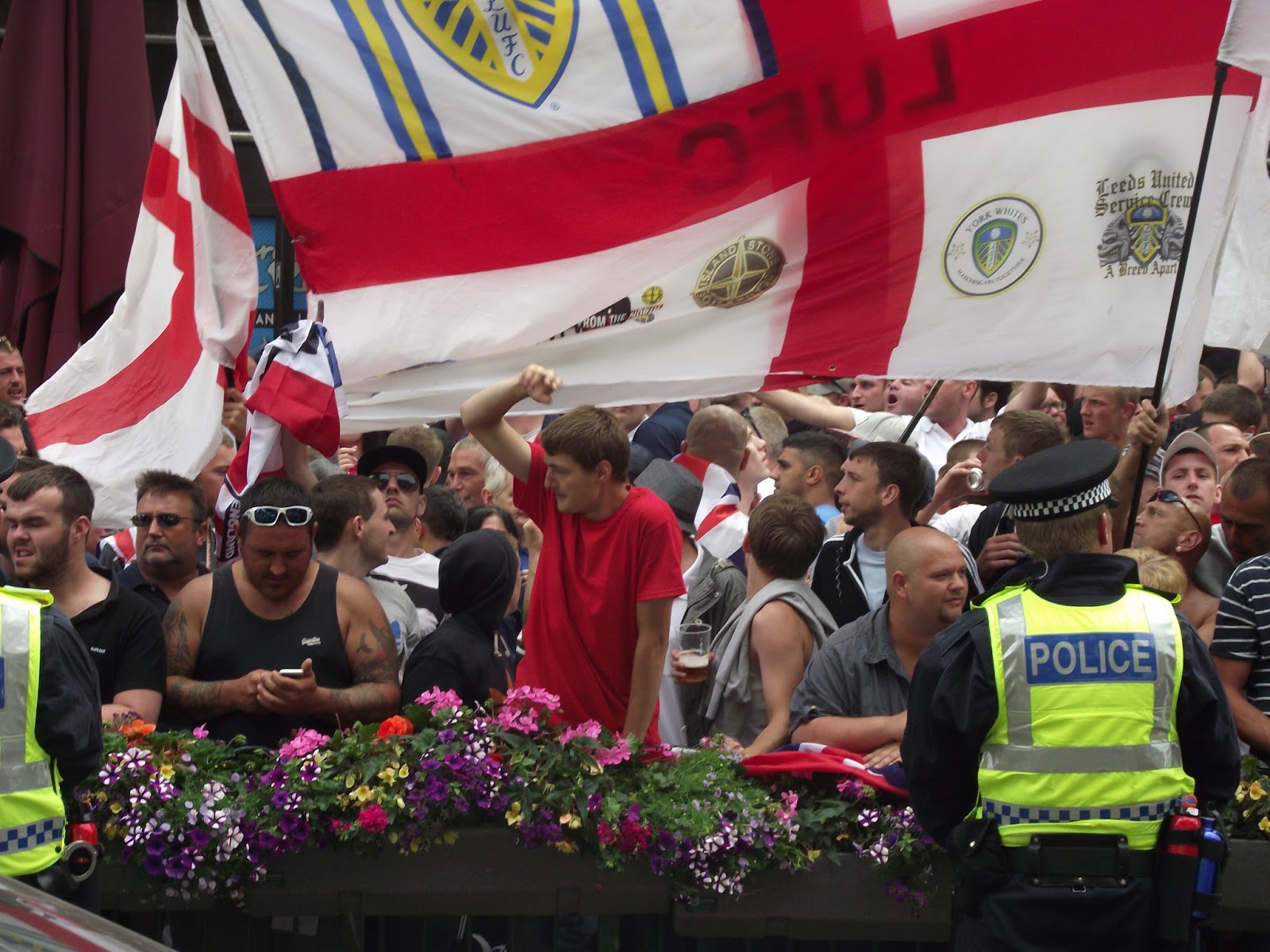
I had an interesting day yesterday, speaking at the antifascist protest in Birmingham, photographing the EDL, and then following the conversations about it on Facebook. The big frustration of the day was when my camera batteries ran out, but at least it gave me an excuse to get out of a situation where the EDL were running riot all round me. It was getting more frightening by the minute, but then I found the UAF protest had been kettled and I couldn't get back in. In the end I went home.


I turned out early, about 11am, as one of the bars in Broad Street, about half a mile from where I live, had been pressurised by the police into hosting them. I complained to the management - these thugs were being let loose on my patch, after all - and got this reply:

Dear Mr Brenchley

We completely understand why this has upset some people and we share their
concerns - we do not, have not and will never support the EDL in any way,
shape or form.

The request to host them came from the police. We initially said no,
however, we were asked several times and we felt we were left with no
option.

The police said their priority is to contain them as a group in one bar to
help ensure the streets of Birmingham are kept safe, and for this reason
they wanted a bar the size of ours.

As I’m sure you can understand, we had little option other than to help
the police manage a difficult situation.

We are not interested in profiting from hosting this group and profits
made during the time they are in the venue will be donated to charity.

Kind regards
Ben

I don't see why they claim they 'had little option'; I've also contacted the Police and Crime Commissioner, but so far the only response has been to promise a reply within 20 days. It'll be interesting to see what his excuse is. The result was to ensure that many of the EDL were already drunk when their rally started. From what I could see from outside, the place was packed. Several coaches unloaded into it during the morning. The police took what appeared to be a beercan off one of them as he disembarked, so some of them may already have been tanked up when they arrived.


I went with another local resident to where they were setting up, and we asked for leaflets. They looked blank and gave us a flag. What sort of organisation doesn't have leaflets to help put its message across? The illiteracy of some of their placards may explain it!


After a while, I went to the UAF protest in Chamberlain Square; the police were moving everyone there as soon as they saw a group of people gathering, but I stayed on my own, and they ignored me.


Everything there was, as you see, perfectly peaceable. I was collared to give an impromptu speech, then immediately afterwards, I went back towards the EDL. The police weren't letting anyone through the direct way, but i went round the back, and reached the police line easily.

There was a lot of aggro going on, with a large group of men making a determined attempt to break through police lines. I managed to slip round the end of the police line without being molested, and joined a group of photographers for a bit, before I moved further on.


I got this pic while balancing on top of a fence. There were about a thousand of them in there, drunk and running wild. They'd already tried to break out  through the new library, which is still a building site. The police had left this unguarded. The police were trying to push them back into their designated area on the far side of the road, with riot shields and sticks out. It got quite violent, and I spotted a man having a terrific altercation with police. I thought it would come to blows, and then I suddenly saw a little boy of about four or so appear, clinging to the man. The police appeared to be trying to get him out of it. I only saw a back view, but other video shows him crying and evidently terrified.


This is someone else's video; the kid is at about the halfway mark:


Eventually I moved further in, until I was right in among them. I felt quite threatened going through the police lines, but the EDL seemed to accept me. I suppose that's something to do with having a deficiency of skin pigment. A Muslim photographer was threatened, abused and pelted with bits of bacon, and apparently it was quite nasty.


I got some brilliant pics, but unfortunately my camera batteries chose that moment to die on me. I was furious, since the same batteries managed well over an hour of filming a few weeks ago, and I wasn't planning on doing anything like that. I slipped out through the police lines, and tried to go back to the UAF protest, but found it had been kettled and I couldn't get back in. Eventually I went home. From what I saw, the police were far better equipped to kettle our perfectly peaceful protest than they were to contain the EDL thugs.Whe I see things like that, I really wonder what they're up to.

There's been a lot of comment since, not all of it complimentary towards the UAF. I felt they weren't well organised. the EDL had it right; they bussed people in from across the country. Antifascists were left to their own devices, so while a few travelled in, it was largely the local people who turned out. Speeches were impromptu, and made by the usual crowd. We need to learn the lesson and get organised on a country-wide basis. Next time, let's have buses from all over - surely a union could be persuaded to put up funds for this - and some nationally known speakers. If we're going to beat people like the EDL, we have to build a mass movement. It's been done before, and it can be done again.

Wednesday, 3 July 2013

Beginning Anew


It's a tragedy that the Left (for once I'm including Labour) was too weak to effectively challenge Thatcher's oft-repeated assertion that 'We have no alternative'. She was lying; there were well tested alternatives to austerity all the time, but, of course, it's going to be a lot harder to make the case now, after thirty years when austerity, under cover of debt and rising house prices, has been the norm. It's been shown that, once North Sea Oil is taken out of the equation, there was no recovery in the Thatcher years. I haven't seen similar figures for the 'New Labour' era, with debt and the housing bubble removed. I seriously wonder how much prosperity they'd show. Wages remained flat, and ever more people came to depend on benefits to top them up. It set us up for a rapacious Tory regime, fostered rack-renting, and created a climate where a monstrosity like the Bedroom Tax could easily be made to look reasonable, at least to those who don't have to pay it.

Part of the reason Thatcher was able to survive long enough to change the political climate for decades to come was sheer luck; the Falklands victory resulted from a combination of Argentine incompetence and chance. The one large ship they lost happened to be the only one they could lose and still retain a chance of victory. The Argentine air force put the wrong fuses on its bombs, ensuring that most of them failed to explode when they hit ships, and their defence of the islands was purely passive, fought by conscripts who fought like lions despite their leadership.

The other factor, which seems entirely lacking in the present regime, was political nous. The lady may have claimed she wasn't for turning, but in fact she turned often and early. She frequently proceeded by increments. The CP (Community Programme) Scheme created jobs for a year, without training, but with pay. It was followed by ET (Employment Training), which provided six months' work with token training, but on benefit plus a tenner, and you were still on a green Giro. The Work Programme is the logical next step in the series.It wasn't till the Poll Tax that she finally lost her marbles.

Back then, most politicians had spent time in the real world; despite marrying money, Thatcher didn't have an affluent background, and this probably contributed to her success. These days, politicians of all parties have often spent their lives cushioned by wealth, and the working lives in the Westminster bubble. The result is that the Tories seem to have no idea about the impact of policies which appear to be dictated entirely by ideology, and the other parties aren't much better. All of them sing from the same hymn sheet, and it offers nothing but decline and hopelessness to anyone but the rich.

The Tories lied their way into power, and are attempting to lie their way through to the next one. Whether they believe in their ability to survive it is anyone's guess; their policies look like a political suicide bombing designed to do maximum damage, with no thought of their chances at the next election. If this article is anything to go by, they're following a blueprint which was drawn up by Thatcher, which was found to be unworkable way back then. Or could they be gambling on Labour's unappealing cowardice to let them in? Their sheer ineptness may yet be our salvation as policies backfire.

They seem to have gambled that Labour and union weakness, public apathy and the vocal support of the right-wing press would see them through without a serious backlash. However, the sheer stupidity of cutting so fast and so deep has guaranteed one. The Bedroom Tax attempts to force people who are already claiming minimal benefits to pay part of their rent out of those benefits. It's an attack on peoples' right to a home, as in order to avoid the tax, without becoming overcrowded, a family would need to move every time the kids reached the right age, then move again each time one left home. Without a long-term settled home, the kids would be less likely to escape poverty themselves. Without being able to keep rooms for sons and daughters at college or absent elsewhere, it would be that bit more difficult to maintain family life after they began to move on. It's hard to escape the conclusion that this is a straightforward attack on  rights which are supposedly safeguarded by the European Convention on Human Rights.

For anyone on benefit, the payment makes up a significant part of their total income; for many people, it's completely unmanageable. Councils round the country have been reporting non-payment rates of between a third and a half, and many more only making part payments. Out of sheer necessity rather than any concerted attempt at resistance, the tax has created what amounts to the biggest rent strike in history. Hence the mounting evidence of panic that we're beginning to see, here, for instance.

 Rent strikes have a history of effectiveness; for instance, the strikes in Glasgow and elsewhere against rent rises during the First World War forced the government to legislate to control rents. The situation here is a difficult one since it's Councils and Housing Associations which are being hurt, and they only have limited influence, if any, on a rampaging Tory regime. Let's not forget that they only changed course on the Poll Tax after Thatcher's fall. Thirty-six Labour Councils asked the government to agree to abolish the Bedroom Tax, but so far even the Labour Party has been too spineless to commit itself to abolition.

With no way it can save money, nowhere to rehouse single tenants, and three-bedroom properties standing empty, the Bedroom Tax is so pointless and so destructive that the battle can surely be won. My biggest concern is the stress and suffering being imposed, for no good reason, on so many people who accepted tenancies on the understanding that, as long as they kept their side of the bargain, they would be theirs for life. In the longer term, the Tories have never been forgiven for the Poll Tax, they've been losing votes steadily for half a century, and this latest piece of lunacy may finally nail them permanently in their coffin with a stake through their hearts. They haven't won an election outright in over twenty years, and I seriously question their ability to bounce back.

In the long term, our problem probably isn't so much the Tories or UKIP. It's Labour, which is likely to be left as the (dubiously) acceptable alternative left standing after the election, despite being too cowardly to do its job in opposition and oppose the government's cuts. I'm not going to speculate about the long-term solution, whether it's to drive them back to the left - if that can be done at all - or to start a new party and replace them. One or the other has to happen as we currently have no Left party to speak of. The Greens do what they can, and deserve more credit for than they often get, but they don't currently have the strength to break through in Parliament. I live in the poorest part of Birmingham, in one of the safest Labour seats around. To all intents and purposes, we have no representation at all.

 History tells us that when a political system fails, as our current one has, it will be replaced. Our real task is to ensure that we build a Left alternative which is strong enough to move into some of political space being left by the decline of the traditional parties. UKIP is moving in on the right, and if we do nothing and remain within our traditional squabbling conventicles, we won't be able to stop them. Socialist Worker has summed it up well here. Fortunately, there are signs that things are beginning to change.

The traditional Left parties have shared the decline of the parliamentary parties, and while it's still far too small to have much impact, the Bedroom Tax campaign in Birmingham is already bigger than any of them. The Peoples' Assembly was even bigger, bringing together people from a wide spectrum, from the Trade Unions, the Labour left, and the Left parties, plus people like me who tend to cry down plagues on all their houses.

This is what we need; a broad coalition of the Left which can brainstorm together, with local meetings which can address local problems as well as the great national and supranational ones, and national gatherings for the latter. If we can maintain it, and build it up, then we have a chance to develop new Left structures which won't work on the old, discredited, top-down system, with everyone expected to toe some party line, and no room for those who don't. The strength of the old Labour Party was that it tried to be broader than that; its current failure is at least partly down to the way it effectively jettisoned the Left in its rush to the right under Blair.

We need something bigger, broader, and more democratic. Maybe we're taking the first steps towards building it, but it's early days yet. It's not enough any more to set ourselves up to 'represent' the people of areas like Ladywood, and aim to give them enough crumbs off the rich man's table to keep their votes in our pockets. We need to give them a real say in the political process.

This needs careful handling, since people with no political awareness are easily distracted. This has been a weakness of grassroots movements since the revolutions of 1848, and probably earlier. Revolutions are regularly hijacked. The overthrow of the puppet governments in eastern Europe at the end of the 1980's was probably needed, but it led too easily to rampant capitalism. The overthrow of the Mubarak regime in Egypt appears to be derailed, though of course we've only seen the first act of what's likely to be a prolonged process.

We can't continue on the old model of the disciplined party where everyone's expected to adhere to a common strategy; it doesn't attract people to the Left any more than a similar policy brings people into the more sectarian churches. The more rigidly enforced the ideas, the harder the boundaries, the smaller the group becomes. We need a new, more open, model where issues can be debated freely, and which can raise political awareness in a broader group of people. Hopefully a Peoples' Assembly, if it can be made to work over a period, will provide part of the answer. A lot of people locally are aware of what's happening, but that needs to be channeled into a mass campaign, and only a new structure will be able to do that. I remain convinced that unions, including Unite Communities, which offers very cheap membership for the unwaged, must be an important part of any successful movement, but they're at a historical low at the moment, and have a long way to go to build themselves up again. Meanwhile, they offered serious backing for the London Peoples' Assembly, and it's very much to be hoped that this will continue.

We've got a long way to go, and the one thing we can be sure of is that the old ways no longer work. We've made a start, but that's all.

Sunday, 23 June 2013

Peoples' Assembly


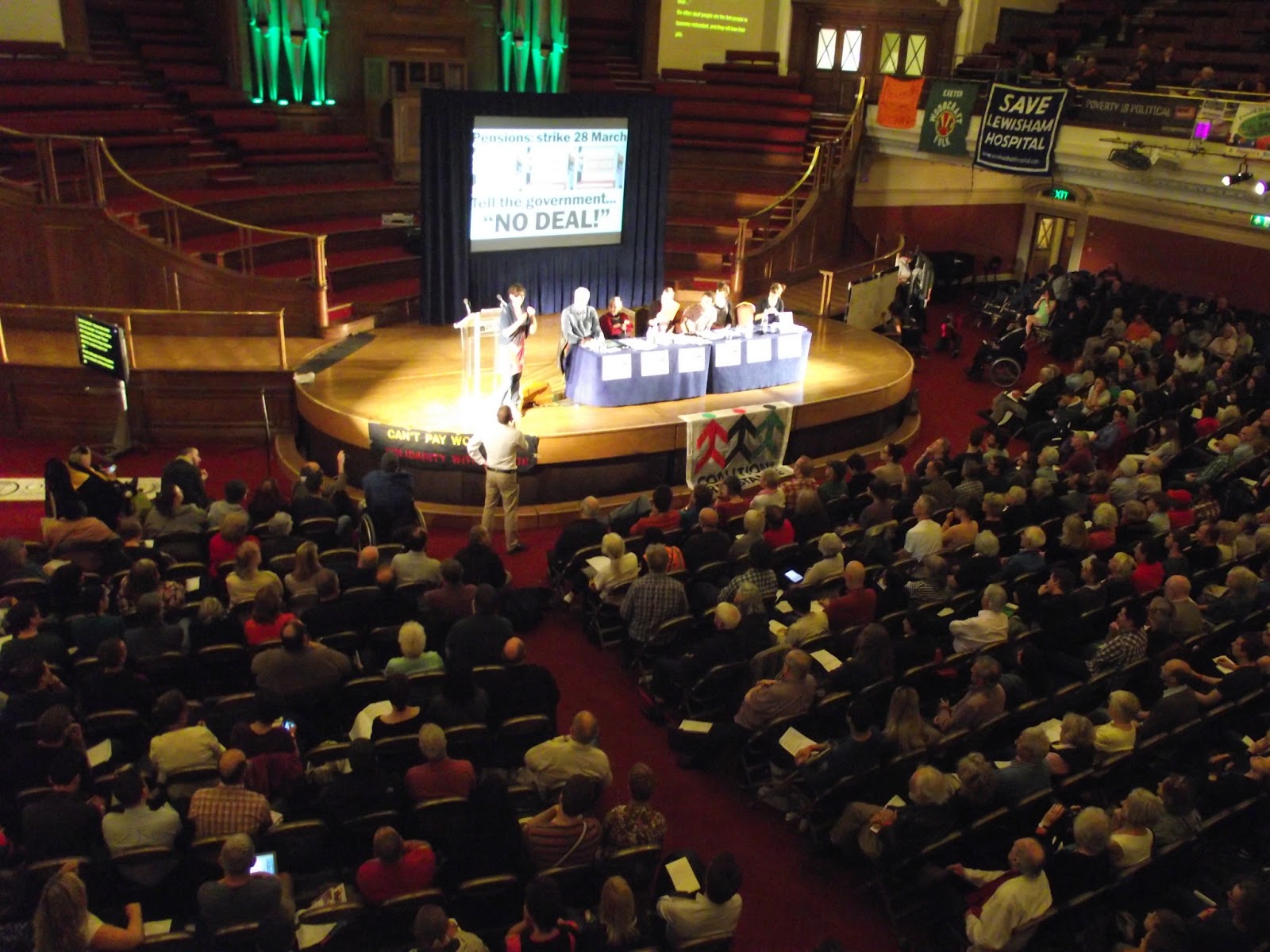
I've neglected this blog a bit, thanks to my usual health problems, but never mind. I was at the Peoples' Assembly yesterday, and it was an inspiring day. The pics are rubbish due to low light levels, but these are the best I got. The venue, at Westminster Central Hall, wasn't ideal, with problems when we broke up into smaller groups. The place is also monstrously expensive, and I'm wondering whether it would be better moved out of London. At one point we had twenty people sitting on the floor in one of the lobbies as we couldn't hear ourselves think in the main room. Never mind, we managed. The crucial thing, though, isn't to have an inspiring day. The Assembly's success or failure will be judged on the action it does, or doesn't, inspire.


There were a great many police around, who seemed to have nothing to do except hang about, bored and trying to look macho. I don't know how they can afford it in an age of austerity. One person was arrested outside after a confrontation with some EDL people, who weren't arrested.  I don't know what happened, but I got some shots of the confrontation with police which followed.

Some of the gloomy prognostications I've heard about it turning into a top-down event where we sat and listened to speeches were wrong. Two out of the three sessions I attended broke down into small groups, and even the one which didn't had a string of speakers.  Obviously, it takes time to build a democratic movement, and we can't expect a baby to walk, talk and use the toilet the moment it comes out of the womb. The Assembly needs to be judged by what comes out of it, and how strong, and how democratic that is.

There's a good article here, with some points to bear in mind. We have to ensure democracy, and then there are problems with Labour and the unions. Maybe Labour can be pushed to the left, maybe it can't. If it can't, how do we respond to that? It's one thing for a union leader to stand up in a meeting and talk about bringing the country to a halt, but nobody's tried to do it since Arthur Scargill and the Miners' Strike. Unions give the Left a great deal of support, financial and otherwise, but how do they respond to all the anti-union legislation that's now in place? Is it still possible for organised labour to make more than a token strike, or do we need to find other forms of resistance? A one-day general strike, for instance, would change nothing, but what about a day a week?


To some extent, the Assembly's still stuck in the old model of a bunch of activists getting together and making decisions without involving the people out there on the street. The danger is, of course, of losing touch with reality, like the people I knew who seemed to spend their lives fantasising about mass popular movements which simply didn't exist. At least we're starting to get away from sectarianism, with all the groups round the country learning how to work together. I still get asked how people can disagree with each other can work together; I come across the same question in a church context as well. It's just a fact of life; people don't always agree about everything, and if that stops us working together, then we won't deserve to get anywhere. If we continue the way we're going, then in time we may get to a point where we don't have to have different organisations fighting, say, the Bedroom Tax, but a single network under a single banner. If nothing else, it would be easier for everyone to relate to.

Then there's the question of how to get a wider group of people involved in the fight. This is crucial; without a mass movement, we're unlikely to get very far. It may come, or it may not, but we can only start where we are. The country's had no real opposition for a generation, so people have no idea, for instance, that there are alternatives to austerity. We need to start convincing people that there is an alternative, that the politicians and the media are lying to us. Then we'll see how they react. They already feel alienated, exploited, lied to. Councils round the country are reporting that a third to a half of people liable for the Bedroom Tax are paying nothing, and many more are only paying part. These figures are liable to rise as resources run out, and the winter cold begins to bite. Obviously, it's happening through simple inability to pay, but we have what amounts to a massive rent strike going on, right across the country. In the coming months, we'll see how able the political system is to handle that. If the tax goes, then people may begin to realise their strength. I go out and talk to people, and they'll willingly tell me how much they hate the Bedroom Tax. Getting them to come out and join a movement is a problem, but part of that may be that they've never seen a mass political movement, and don't know what it can achieve. We just don't know, and it's no good trying to second-guess the future.

There's a link here to a statement which was agreed - as far as I could see unanimously - at the Assembly. There was no opportunity to amend it on the day, and it might have led to chaos if there had been. However, there's nothing to stop a future Assembly from doing so. I think we should treat it as something up for discussion, not something set in stone.

Like all things we do, the Assembly wasn't perfect, but I felt it was a good start. We need to keep going, build local Assemblies, and try to widen the conversation. I hope the critics will get involved, and try to make it better!

Thursday, 23 May 2013

Not in God's name


I don't know whether yesterday's murder in Woolwich deserves to be described as 'terrorism' or not, but the subsequent attack of one mosque, and attempted attack on another, were certainly hate crime.Politicians and the media stir up Islamophobia all the time, create tension nobody needs, and the result is that a couple of peoples' action has created a situation where mosques are being attacked, and my wife is afraid to visit the local mosque. I've come across Facebook postings where people were claiming that Muslims aren't condemning what happened. Let's make it clear that they are. I hesistate to link to the Muslim pages on Facebook which I took these images from because of the hate being spewed across them.

I've been married for coming up to eighteen years, I've met a great many Muslims, and I've yet to come across a single one who believed that violence was ever justified in God's name.


Friday, 17 May 2013

Lobby of Albert Bore's Surgery, and Other Matters


It's been a hectic week. I had a bad cold all last week, which left me fit for nothing. Then on Saturday I was in Westminster Central Hall, opposite the Houses of Parliament, for a national anti-cuts meeting. There were over 300 people attending, and we decided to form a national anti-cuts federation, open to all the groups fighting the cuts.

I spent most of the day sitting there in a daze, then had to take a service at my church next morning. One of our Worship Leaders did everything but the sermon - that's the advantage of my church; we're very participatory, with a lot of talented people, so the preacher doesn't have to do too much - and preached on Revelation. This was quite apposite, as I always feel it was written as a warning to a church which was getting too comfortable with Roman rule. And here we are, with many of the congregation being kicked in the teeth by the government.

Then I had to rush straight off after a cup of tea, to the first Birmingham Anti-Cuts Federation meeting. 38 people were there, from sixteen different groups across the city.


That was quite constructive, and I ended un in a small group afterwards discussing standing Left candidates for the Council. I think this is important; the Labour administration is hopeless, there are wards like mine where nobody ever bothers to campaign, and we need to shake things up and offer an alternative.

Then on Wednesday I was at a meeting of the local Ladywood group. We hadn't done the leafleting we did last time, but nineteen people came, we heard more awful stories, and it's beginning to feel as though we have a campaign going.


Tonight we had a lobby of Albert Bore's surgery at the Council House - which is an odd, intimidating place to have it - with about twenty people picketing outside. We met in Ladywood, and six people walked up the canal into town together while i dashed back home as I'd forgotten the camera.

The people at the Council house responded by bolting the door, and only letting two people in at a time. That was rapidly reduced to one. So rather than several local residents seeing him together, and delivering a petition, everyone had to see him one at a time, and it took up his whole surgery, which ended up overrunning. Towards the end, the guy on the door got quite stroppy; Bore didn't want to see any more Bedroom Tax people. We had an argument with him, and insisted on his letting the last one in. She had a very perfunctory meeting, with Bore complaining about the time.

I didn't see him myself, but apparently he wasn't very helpful at all, and wouldn't commit himself to anything. Altogether not the response we'd have hoped for; refusing to see us together was particularly bad, and made it far more intimidating than it needed to be. We seem to be making an impact, though!